
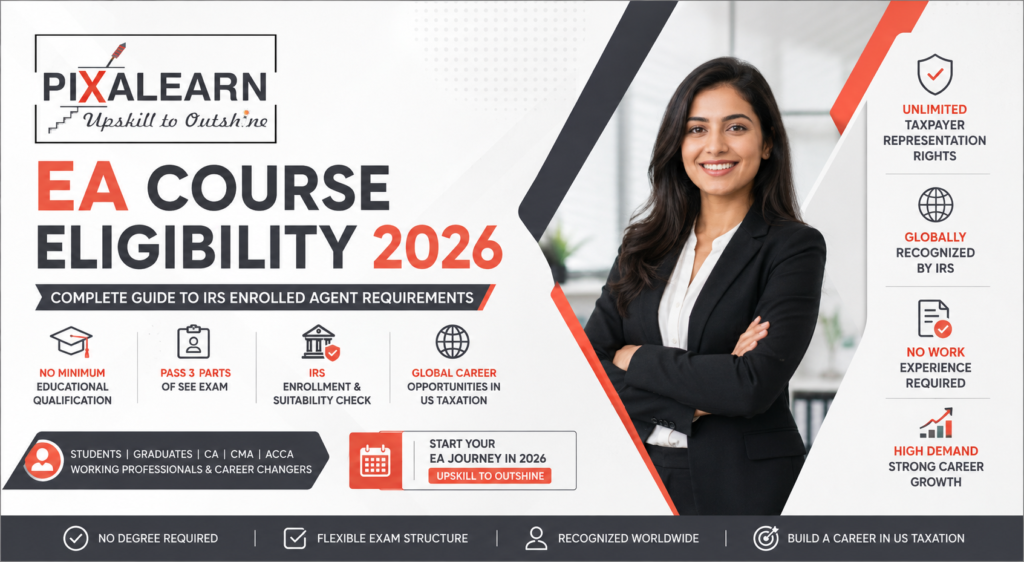
The Enrolled Agent (EA) credential is one of the most respected certifications in the field of taxation. Awarded directly by the Internal Revenue Service (IRS), the EA designation allows professionals to represent taxpayers before the IRS for tax matters, audits, collections, and appeals. Unlike many professional accounting certifications, the EA course has flexible eligibility requirements, making it accessible to students, graduates, accountants, tax professionals, and career changers.
If you are planning to pursue the EA course in 2026, understanding the latest eligibility requirements is the first step toward building a career in US taxation.
What Is an Enrolled Agent (EA)?
An Enrolled Agent is a federally authorized tax practitioner who has earned the right to represent taxpayers before the IRS. EAs possess unlimited practice rights, meaning they can represent any taxpayer, handle any type of tax matter, and appear before all IRS offices. The credential is recognized throughout the United States and is increasingly valued by global accounting firms and multinational companies.
EA Course Eligibility 2026: Quick Answer
One of the biggest advantages of the EA certification is that there are no strict educational requirements.
To become an Enrolled Agent in 2026, candidates generally need to:
- Obtain a Preparer Tax Identification Number (PTIN)
- Pass all three parts of the Special Enrollment Examination (SEE)
- Apply for enrollment with the IRS
- Clear the IRS suitability check, including tax compliance and background verification
The IRS does not require candidates to hold a specific degree, accounting qualification, or prior tax experience before appearing for the EA examination.
Is There Any Minimum Educational Qualification for EA?
No, The IRS does not mandate a bachelor\’s degree, commerce background, CA qualification, or accounting degree to become an Enrolled Agent. Candidates from various educational backgrounds can pursue the EA certification provided they can successfully pass the Special Enrollment Examination.
This flexibility makes EA one of the most accessible international taxation certifications available today.
Can Indian Students Pursue the EA Course?
Yes, Indian students and professionals are eligible to pursue the EA credential. Since the examination focuses on US taxation laws and IRS procedures, candidates from India can prepare for and complete the certification process remotely. The EA credential has gained popularity among Indian professionals seeking careers in:
- US Taxation
- Tax Consulting
- Global Accounting
- Big Four Firms
- Shared Service Centers
- International Tax Compliance
Who Can Apply for the EA Course in 2026?
The following candidates can pursue the EA certification:
Students
Commerce and accounting students interested in international taxation can start preparing for the EA examination.
B.Com and M.Com Graduates
Graduates looking to specialize in US taxation often choose EA as a career-focused certification.
Chartered Accountants (CA)
Many CAs pursue EA to expand their expertise into US tax regulations and international tax services.
CMA and ACCA Professionals
Finance professionals seeking global opportunities frequently add EA to strengthen their tax credentials.
Working Professionals
Accountants, tax consultants, auditors, and finance executives can pursue EA while continuing their jobs.
Is Work Experience Required for EA Eligibility?
No.
The IRS does not require candidates to possess prior tax preparation or accounting experience before taking the EA exam. However, practical experience in taxation can make exam preparation easier and improve career opportunities after certification.
Age Limit for EA Course
The IRS does not prescribe a minimum or maximum age limit specifically for becoming an Enrolled Agent. Candidates who can obtain a PTIN and satisfy IRS requirements may pursue the credential.
EA Exam Structure 2026
To become an Enrolled Agent, candidates must pass all three parts of the Special Enrollment Examination (SEE) within a three-year period.
The exam consists of:
Part 1: Individuals
Covers individual taxation, income, deductions, credits, and tax procedures.
Part 2: Businesses
Focuses on business taxation, partnerships, corporations, and business tax compliance.
Part 3: Representation, Practices and Procedures
Covers IRS representation, ethics, collections, appeals, and professional responsibilities.
Candidates can take the exam sections in any order.
Important EA Exam Updates for 2026
The IRS has transitioned the administration of the Special Enrollment Examination from Prometric to PSI Services. Registration and scheduling for the 2026 testing cycle are now conducted through PSI. Candidates must pass all three exam parts within three years of passing their first section.
IRS Suitability Check Requirements
After passing the examination, applicants must complete an IRS suitability review. This process includes:
- Verification of tax filing compliance
- Review of outstanding tax liabilities
- Criminal background review
- Assessment of professional conduct
Candidates who meet IRS standards can proceed with enrollment.
Benefits of Choosing the EA Course
The EA credential offers several advantages:
- Globally recognized tax qualification
- Direct authorization from the IRS
- Unlimited taxpayer representation rights
- Growing demand in India and worldwide
- No mandatory degree requirement
- Flexible exam structure
- Strong career opportunities in US taxation
Conclusion
The EA course remains one of the most accessible and valuable international taxation certifications in 2026. Unlike many professional qualifications, the IRS does not require a specific degree, prior work experience, or accounting background to begin the journey. Whether you are a student, graduate, CA, CMA, ACCA professional, or working accountant, the EA credential can open doors to rewarding opportunities in US taxation and global finance.
With flexible eligibility requirements and growing demand for US tax professionals, 2026 is an excellent time to start your EA journey.
Frequently Asked Questions
Can a B.Com student apply for EA?
Yes. B.Com students and graduates are eligible to pursue the EA course.
Can a non-commerce student become an EA?
Yes. The IRS does not restrict eligibility based on educational background.
Is CA required for EA?
No. Chartered Accountancy is not required for EA eligibility.
Is work experience mandatory?
No. Candidates can pursue EA without prior work experience.
How many exams are there in EA?
There are three parts in the Special Enrollment Examination (SEE).
Who issues the EA credential?
The Internal Revenue Service (IRS) awards the Enrolled Agent designation.